

We all make goals.
Fitness goals, career goals, life goals, once a year goals called New Year’s Resolutions, big goals, small goals, and many more kinds of goals. Any goal you can think of, someone, somewhere is either making it a goal or working towards it.
Unfortunately, many people are also breaking their goals. I know I’ve had plenty of diet goals that fizzled out as soon as I saw a McDonald’s drive-thru or a pack of Chips Ahoy cookies. How many of your goals have you let fade away as a phase? If you, or someone you know, has made goals and never achieved them, you may be wondering, “Why set goals in the first place if I probably will never reach them?”
Goals Give Meaning
Even if you never meet a single goal you’ve set in life, for a period of time, each of those goals gave you a purpose. During that time, every decision you made was made with gumption and confidence that you were destined for something greater.
Setting those goals in the first place gave you a reason to see what is truly important in your life.
See, the thing with goals is you never truly know if you are going to reach them or not. All the confidence in the world isn’t strong enough to overcome some hurdles and will-power alone isn’t the strongest force there is. But, don’t be discouraged! There are some things you can do when setting your goals that will increase your chances of accomplishing them!
First, let’s get a better idea of what a goal really is.

What’s a Goal?
Take a look at these definitions of two separate nouns;
- “An expressed will or desire”
- “The end toward which effort is directed”
Now take a look at these two examples;
- “I want to go to Disneyland next summer.”
- “I am saving money from every check so I can go to Disneyland next summer.”
Which definition and which scenario did you relate more closely to when it comes to goals?
Is it a Goal, or is it a Wish?
Did you most closely relate to the A’s, which were the definition and an example of a wish? Or did you most closely relate to the B’s which were the definition and an example of a goal?
Either way, did you notice that that only difference between the two were that the goal set included effort or action? Saying you want something is a wish, but actually working towards that wish makes it a goal.
But how do you turn a wish into a goal? What steps do you take?
Types of Goals:
The steps you take to reach your goal depends entirely on what that goal is. But, even so, every big goal should be broken down into smaller, more achievable goals. By arranging your smaller goals so that they feed directly into your larger goals, you are setting yourself up for success. Here is a brief overview of all three “sizes” of goals;
1. Outcome Goals: Large, specific and based on the desired end results. Although this is the most commonly used goal type, I prefer to use this form of goal setting for long-term goals. Because they are all or nothing-you make it or you don’t-outcome goals are best used as finish lines for short- and medium-sized goals. For me, these are my year goals.
2. Performance Goals: Although they are also based on a desired end result, performance goals help you narrow your focus down to your outcome. Occasionally comparing your day to day activities to your medium-sized performance goals can help you evaluate if your effort is leading you to where you want to be or is taking you far away from your path. For me, these are my monthly targets.
3. Process Goals: These are the type of goals that we should put the most emphasis on. These are the small goals that you strive to accomplish every day and week with your actions and behaviors. These are the goals that depend 100% on you. They are completely under your control.
For more information on these three types of goals, check out this article by Kenneth MD. https://www.kennethmd.com/three-types-of-goals/
Think Big First
Everyone can set big goals, but it is the Process Goals that will help you keep them!
But just like you have to bake an entire cake before you eat it one bite at a time, we have to create our big goal first. Now, you may have come to this post for help keeping a particular type of goal, a long list of goals or just for information to store away later, and either way, the process will still be the same, and it will start with setting a big Outcome Goal.
I personally don’t like to set five-year, 10-year, or beyond-year goals because life is so sporadic and all the planning in the world can’t stop economic depressions, natural disasters or personal crisis’, so I just stick to one-year goals. If someone really wants to know where I see myself in five years, I’ll just multiply my one-year goal by 2.5 or something.
To help you follow along with this article, I will set an example goal with you.
Let’s say your example big, long-term, outcome goal will be to save money for a trip to a local theme park. It will cost $1000 for tickets, travel, food and lodging and you have one year to save up for it. (If this number does not fit your lifestyle, feel free to multiply it and follow along with your own figures.)
You are satisfied with your goal, and now you want to make sure that you keep it! How can you do that?
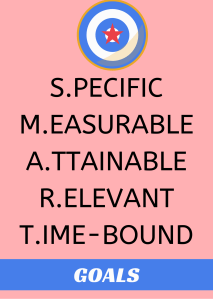
S.M.A.R.T. Goals
Disclaimer: Goals are not set in stone! You can always adjust your goal as circumstances change!
But if you are satisfied with your big Outcome Goal and just want to make sure that it is an attainable goal in the first place. A way to measure the attainability of goals is to compare them to the S.M.A.R.T. chart. Goals that are Specific, Measurable, Attainable, Relevant and Time-Bound are S.M.A.R.T. Let’s see if your savings goal is S.M.A.R.T.
Specific – Save $1,000
Measurable – Money is measurable, and you can measure what’s in your savings account or envelope
Attainable – You know you are able to confidently save $84 a month
Relevant – You really just want to go. This goal is relevant TO YOU.
Time-Bound – You have one year to achieve this goal
After comparing your Outcome Goal of saving $1000 to go on a theme park vacation, it turns out your Outcome Goal is S.M.A.R.T.! As a plus, when calculating to see if your goal was attainable, you actually set up our Performance Goal!
Remember, Performance Goals are what determine if you are on track to reaching your Outcome Goal. When you established how much you would have to save each month to reach $1,000 is $84 for 12 months, you set your Performance Goal! If you save that amount each month, then you’re on track to your Outcome Goal! If you don’t reach it, then you need to evaluate why not.
Now that you have set an Outcome Goal, and, inadvertently, your Performance Goal to track progress towards it, let’s set up some Process Goals to chart your steps.
Bite Sized Process Goals
When you set your grand, long-term, Outcome Goal, was it easy for you to see exactly and specifically how you would make it there? Probably not. It was so far away that you probably couldn’t think of everything that would have to go into it.
Once you broke down your Outcome Goal into a smaller Performance Goal, did it seem a lot more obtainable? I bet it did! But let’s break that down into goals that are even easier for you to reach; the Process Goals.
As mentioned earlier, Process Goals are the goals we strive to accomplish every day with our actions and behaviors. This is where effort comes in to play to turn your wish into a goal.
Some of the Process Goals needed to forge your path may be so obvious it is insane. Others may be elusive, and you can’t quite pin them down just yet. Some may not even be realized until further down the road. And that’s fine. These are your goals and you can fine tune them any way you see fit! But today, let’s focus on the obvious Process Goals.
We know that in order to reach your big Outcome Goal of saving $1,000 to go to a local theme park, you need to save $84 a month for 12 months. But how can you do that? What can you, yourself, do to make sure that you reach that goal?
Well, to reach that goal, you need income. It’s reasonable to assume that if you are planning a theme park trip that you have a job to pay for it, or some other form of income. Let’s say you get paid every week; how much would you have to save a week to reach $84?
84(dollars) / 4(weeks) = $21 a week.
So, you would need to save $21 a week to meet – and exceed – $84 a month. (Or $42 from each check if you are paid biweekly or twice a month.) This is still a Performance Goal, although smaller and weekly, to use to track your path towards your larger, monthly Performance Goal and Ultimate Outcome Goal.
How can you make sure that you save $21 a week? What actions do you need to take to make sure that you save-and don’t spend-that money? Once you determine what actions are needed, you will know what your Process Goals need to be.
Let’s start with the most obvious method of saving money. Working harder. If you work more shifts or longer hours, your check will increase, giving you more money that you can save without affecting your usual living expenses. To determine how many hours extra you need to work to increase your check by $21, divide $21 by your hourly wage, then add an extra hour for taxes.
Taking advantage every day of opportunities to increase your work hours is a Process Goal. Even though your boss has to offer it, it’s up to you to say, “Yes!”
Another way to save money that is equally as obvious yet significantly harder is to spend less. But, let’s face it, we aren’t going to cancel our Wi-Fi or our cell phone service and we really prefer our electricity on, so what can you spend less money on?
I’m sure a few ideas filtered through your head, but for the sake of consistency, I’ll just dive into two Process Goals that relate directly to the at-work basis of the last one.
Bringing lunch to work for a few days a week is a subtle, yet powerful, way to save money. You can even take it a step further and put the money you would have spent for lunch in your savings! Plus, you are in control of how many days a week will you chart out for this Process Goal! Is it possible for you to pick out a day or two-once it warms up-to walk to work? How about carpool? Just like your lunch money, you can put the money you didn’t use on gas in your savings!
Using these smaller Process Goals together with your weekly Performance Goal of saving $21 can get you to your goal-and vacation-faster!
View Your Goals in Reverse
When we set up your goal of saving money $1,000 to go on a theme park vacation, we worked from the big Outcome Goal to break it down into the small Process Goals. To get a better view of what we just created, let’s take a look from the bottom up, starting with our day-to-day Process Goals.
Process Goals:
Each day you should put in the effort to accomplish these Process Goals:
- Work Longer Shifts
- Bring Lunch from Home – Save The Money You Would Have Spent on Takeout
- Walk or Carpool – Save The money You Would Have Put in Your Tank
At the end of each week, your bank account should reflect that you made-or saved-enough money to transfer at least $21 to your savings account. If you are confident you can transfer more money over without taking it back out, awesome! You’re ahead of schedule!
Your effort from the past week should lead you to your weekly Performance Goal:
- Saving $21 a week
And, if you have saved $21 every week for a month, you should be on track to your monthly Performance Goal:
- Saving $84 a month
And $84 a month for 12 months equals $1008!
Yay! You have reached your big Outcome Goal:
- Save $1000 to go on a theme park vacation!
Congratulations! It took about 30 minutes to set up your goal for the next year! What other goals do you want to plan for? Just remember:
- Start big!
- Make sure your goal is S.M.A.R.T.!
- Specific
- Measurable
- Attainable
- Relevant
- Time-Bound
- Have Performance Goals to compare your progress to and make sure your aimed in the right direction!
- Create Process Goals to strategize your efforts!
- Track all of your Outcome Goals, Performance Goals and Process Goals in a Goalkeeper like the free downloadable Goal Keeper available here!
Feel like you can take over the world yet?
Go for it!
Faith
I left this section for last because I know that there are some people who may not want to hear this, but reaching goals truly requires a certain level of faith.
The Bible defines faith in this way; “The assured expectation of what is hoped for, the evident demonstration of realities not seen.”
The Miriam-Webster dictionary defines faith like this; “Firm belief in something for which there is no proof.”
What would be your attitude towards putting any effort into a goal if you don’t have faith that you will achieve it? You’ll probably be too discouraged to rustle up any effort at all! But if you have faith, or a strong belief, that you will accomplish your goal, you will evidently demonstrate it with your actions and effort!
Remember, the only difference between a wish and a goal is the effort you put into it!
Want to make sure you never miss the latest Clerical Thoughts content?


 Davis Virtual Support